
Patch & badge embroidery designs
Round and shield-shaped patches, badges, ribbon banners, frames and borders, finished with clean satin edges: these patch and badge embroidery designs let you make your own patches at home. Free patch files come in PES, JEF, EXP, VP3 and DST, so they run on Brother, Janome, Bernina, Husqvarna Viking and most other machines. Stitch patches on cotton twill or felt with a firm stabilizer, then cut them out close to the satin border.
2 designs
- Premium
- Premium
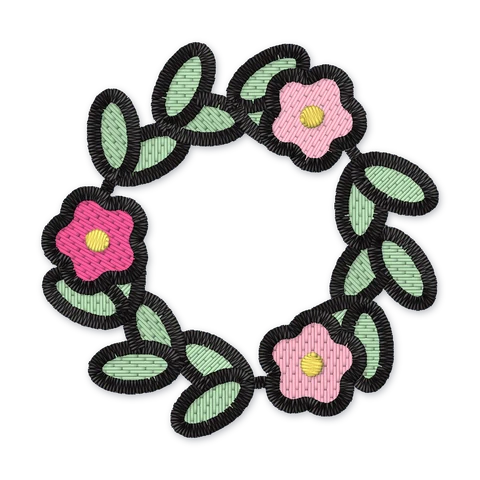
What is in this category
Three groups share this page. Embroidered patch designs are stand-alone motifs with a wide satin border that you cut out and attach, and badges and emblems are generic shields, crests, seals and ribbon banners for clubs and teams, never the logo of a real organization. Frames and borders are outlines and corner pieces to set around names, dates and other motifs.
Felt does not fray, so you can also stitch a motif from another category on felt and cut around it with a small margin. A summit or a compass from the adventure designs makes a good first patch for a hiking backpack.
Making patches at home
Cotton or polyester twill is the classic patch base because its tight weave holds dense stitching, while felt is the easiest to cut. Both need a heavy tear-away or a cut-away below, so the satin border closes evenly all the way around.
Pick a base fabric in the patch's background color, so the cut edge disappears even if you trim a hair too wide. The satin border is the home-machine version of the rolled merrow edge on commercial patches, and on a well-hooped twill base it gives a similarly tidy finish.
Sew-on or iron-on backing
Sew-on patches are the most durable choice for jackets, backpacks and anything washed often. Stitch around the patch by machine, just inside the satin border, with a straight or narrow zigzag stitch in matching thread.
Iron-on backing is a heat-activated adhesive fused to the back of the patch. It is quick on cotton and denim, but it can lift after many washes and does not suit nylon, waterproof shells or other heat-sensitive fabrics. Many people iron a patch on to fix its position and then sew around it as well.
Patches and badges for clubs, events and shops
Patches suit club vests, camp shirts, team bags and event souvenirs, and small shops sell them on their own or stitched onto caps and jackets. Club names, team names and years can go on a blank banner: type them in the monogram maker and place them on your machine's screen. If you plan to sell patches made from our files, choose a plan with a commercial license.
Frequently asked questions
How do I make an embroidered patch with my embroidery machine?
Hoop cotton twill or felt with a firm stabilizer, stitch the patch design including its satin border, and take it out of the hoop. Trim away the stabilizer and cut close around the border without nicking it. Finally, sew the patch on or give it an iron-on adhesive backing.
What is the difference between a patch, a badge and an emblem?
The words overlap in embroidery. A patch is any stitched piece you cut out and attach, while a badge or an emblem is usually a shield, crest or seal shape that stands for a group. Here, patches are cut-out motifs with a satin border and badges are generic shields and banners, and both can also be stitched straight onto a garment.
Can I embroider a patch design directly on a jacket?
Yes. Hoop the jacket panel with a cut-away or a firm tear-away and stitch the design straight onto it, skipping the cutting; the satin border then works as a decorative frame. On thick, padded or coated jackets, a separate patch that you sew on is still the easier route.
Can I sell patches made from these designs?
Yes. Selling patches, whether online, at markets or to a club, requires a plan with commercial rights, because the free license only covers personal use. All details are on the license page.